
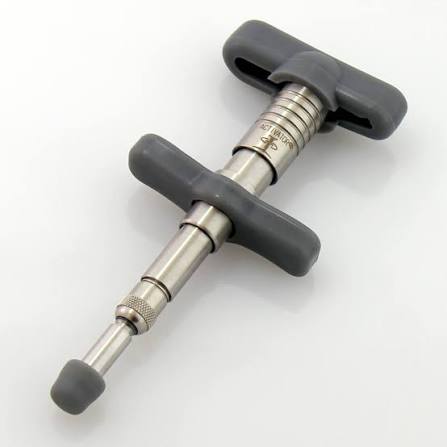
Patients ask us some version of the same question almost every week: “Was that it?” They’ve just had their first Activator adjustment. They felt a quick click against their back, and nothing popped. If you grew up thinking chiropractic means cracking, a light tap can feel like the doctor skipped a step.
So does it work? For low back pain, sacroiliac joint pain, jaw pain and tight shoulder muscles, the published trials say it helps about as much as a hands-on adjustment. For the rest of the spine, nobody has studied it well enough to say one way or the other. Both halves of that answer matter if you’re deciding whether to try it.
What the instrument actually does
The Activator is a small, spring-loaded handheld tool. When it fires, it pushes a rubber tip into one joint with a very fast, very light thrust. Nobody twists your neck or rolls you onto your side. Dr. Arlan Fuhr developed the method in 1967, and the instrument followed about a decade later.
It isn’t a niche technique. A 2005 job analysis by the National Board of Chiropractic Examiners found that 51% of U.S. chiropractors had used an Activator, which makes it one of the most widely used tools in the profession.
What the studies found
In 2012, a team at the Canadian Memorial Chiropractic College went looking for clinical trials on the Activator and found eight that met their standards. Patients in those trials did about as well with the Activator as with manual adjustments or trigger point therapy. The conditions were acute and chronic low back pain, sacroiliac joint pain, jaw (TMJ) problems, and trigger points in the upper trapezius, the muscle that knots up between your neck and shoulder.
A 2023 review cast a wider net and included 23 studies. For the low back, the sacroiliac joint and the tailbone, it landed in the same place: where the research exists, pain relief with the Activator falls in the same range as manual adjustments.
What the studies didn’t find
Most of those trials were small. Many followed patients for only a few weeks, and few compared the Activator against a sham treatment, which is the best way to rule out a placebo effect. The 2012 authors said so in their own paper.
The 2023 review also turned up almost no research, positive or negative, on the Activator for the mid back or the full spine. That’s a hole in the evidence. It isn’t proof that the Activator fails there.
I don’t think this makes the Activator unusual. A lot of everyday care for back and neck pain, physical therapy exercises included, rests on studies just as thin. It does mean we treat the Activator as one option inside a plan, not as the plan.
When we reach for it
In our office, the Activator comes out most often when a manual adjustment would be harder on the patient than it needs to be. That covers older patients with fragile bones, people in the first few days after a back or neck strain when every muscle is guarding, and anyone who tenses up the moment they lie down on the table. It’s also useful for small joints like the wrist, ankle and jaw, where a precise contact matters more than force.
Plenty of patients end up with a mix: the Activator on a sore low back, a manual adjustment somewhere else. Our Activator Method page goes into more detail on who it suits, including pregnant patients and teens.
If you want to try it
You can ask for the Activator by name, including on your first visit, and most new patients start treatment the same day as their exam. If you haven’t seen a chiropractor before, our post on what to expect at your first visit walks through the appointment.
We see patients from Vancouver, Camas and Portland at our office on East 22nd Street. Call (360) 573-5500 or book with an Activator chiropractor in Vancouver, WA.
Sources
- Huggins T, et al. Clinical effectiveness of the Activator Adjusting Instrument in the management of musculoskeletal disorders: a systematic review of the literature. J Can Chiropr Assoc. 2012;56(1):49-57.
- Melvill RP. A systematic review of the effectiveness of the use of the Activator Adjusting Instrument in treating spinal pain. Durban University of Technology, 2023.
- Fuhr AW, Menke JM. Status of Activator Methods chiropractic technique, theory, and practice. J Manipulative Physiol Ther. 2005;28(2):e1-e20.
- Letter to the editor citing the 2005 NBCE Job Analysis. J Can Chiropr Assoc. 2012;56(2).